


 More Blog Posts
October 2026 - Market Recap


- In the November 3 midterms, Democrats won control of both the House and the Senate, according to network projections, and stocks moved higher in early trading on November 4 as investors weighed what divided government could mean for spending and Treasury yields.
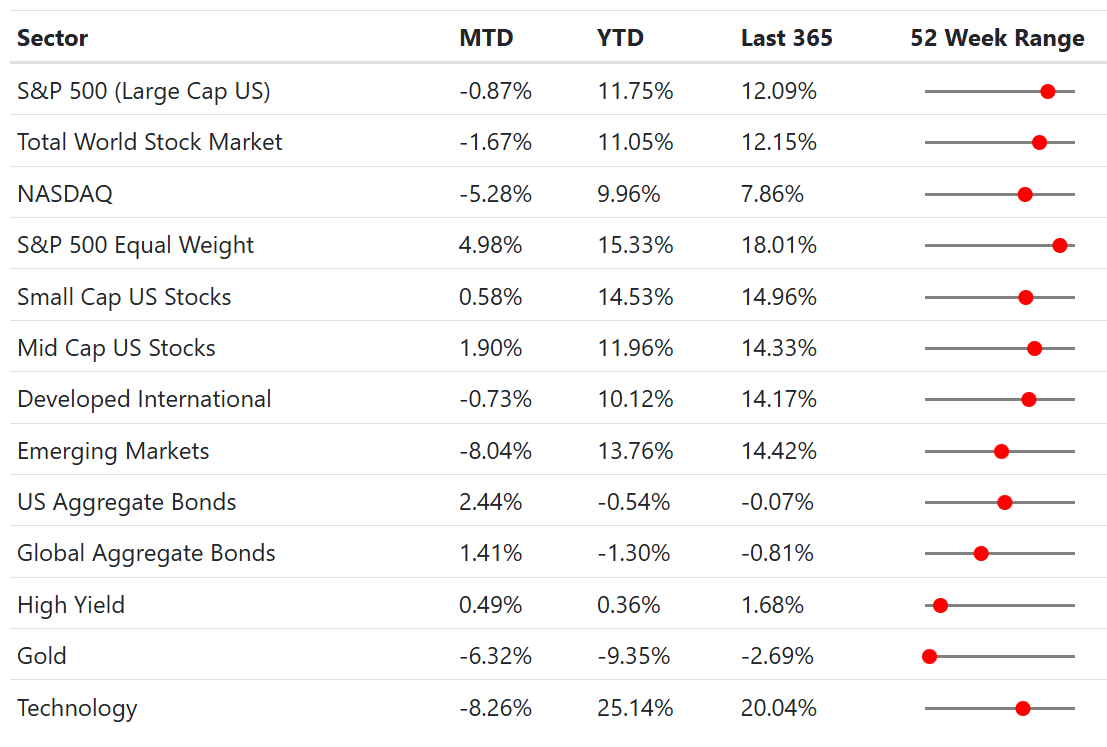
- The biggest tech companies fell, and most other stocks rose. The S&P 500 slipped 0.9%, but the equal-weighted S&P 500 gained 5.0%. That was the widest gap in the typical stock's favor since 2009, as investors questioned how quickly heavy AI spending will pay off.
- Defensive sectors and energy led. Energy jumped 13.9% as oil climbed on renewed trouble in the Strait of Hormuz, while Communication Services and Technology fell 10.0% and 8.3%.
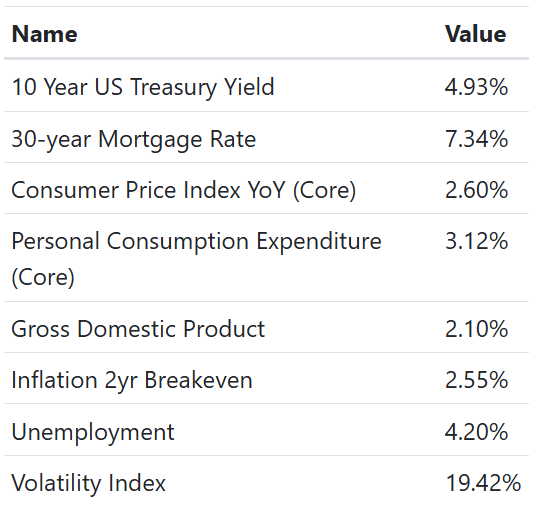
- Bonds rallied as investors sought safety. The 10-year Treasury yield fell to 4.93% from 5.29%, and U.S. bonds gained 2.4%, recovering most of September's loss.
- The Fed held rates steady but left the door open to another hike. Two officials voted for an increase, and markets expect a move in December.
Data Dashboard
Stock Market
The S&P 500 fell 0.9% in October, but the index tells only part of the story. The month's main event was a sharp turn away from the largest technology companies. Investors grew uneasy about how much these companies are spending on AI data centers and how long it will take to earn it back. Money moved into the rest of the market instead. The index closed October within a penny of where it stood at the end of May.
That rotation shows up clearly beneath the surface. The equal-weighted S&P 500, which gives every company the same weight, rose 5.0%. Its lead over the regular index was the largest since April 2009. Mid-cap stocks gained 1.9% and small caps 0.6%. The style gap was even wider. Value stocks beat growth stocks by about 10.5 percentage points, one of the largest monthly margins on record, according to Confluence Financial Partners.
Sector results were split almost in two. Energy (+13.9%) led as U.S. oil prices rose about 14%. Tensions over the Strait of Hormuz flared again, and Iran declared it closed on October 26. Defensive sectors followed: Consumer Staples (+11.0%), Utilities (+10.2%) and Health Care (+9.9%). At the bottom, Communication Services (-10.0%) and Technology (-8.3%) fell the most. They hold the companies at the center of the AI debate, and a semiconductor index fell about 9% for the month.
Third-quarter earnings were solid overall but judged harshly where spending outran cash. With about 60% of S&P 500 companies reported, 82% beat profit estimates. JPMorgan opened the season with its first miss in nearly three years, though bank results were mixed rather than weak. The month's defining report came from Alphabet. It spent $51 billion on capital projects in the quarter, more than its operations brought in, and missed earnings estimates. The stock fell about 13% on October 29, its worst day since going public. Amazon missed profit estimates the same week, and its shares fell the next day. Its free cash flow over the past year has turned negative. Intel beat estimates but warned about the coming quarter, and its shares dropped about 29%. The message from investors: AI growth is welcome, but they now want to see it in the cash flow.
Overseas results split along the same line. Developed international stocks slipped 0.7%, as gains in Europe were offset by a 7.4% drop in Japan. Emerging markets fell 8.0%. That index leans heavily on Asian technology companies, and Chinese stocks also fell about 6%.
October Return Summary (by GICS Sector)
Bond Market
The Fed held its benchmark rate at 3.75%–4.00% on October 28, a month after September's hike. The vote was 10–2. Governor Lisa Cook and Cleveland Fed President Beth Hammack both wanted another quarter-point increase. The Fed described the economy as "strong" and said inflation "remains elevated." Markets took that as a pause, not an end. Futures point to a likely hike in December.
The 10-year Treasury yield fell from 5.29% to 4.93%, its largest monthly drop since December 2023. The Fed wasn't the reason. Investors moved money from technology stocks into Treasuries, and funds that manage to a set level of risk bought bonds as stock swings picked up. Falling yields lift the value of existing bonds. U.S. Aggregate Bonds gained 2.4%, erasing nearly all of September's loss, and Global Aggregate Bonds rose 1.4%.
High Yield bonds gained just 0.5%, trailing investment-grade bonds by a wide margin. Part of that is simple: lower-rated bonds are less sensitive to falling Treasury yields. But some heavily indebted companies tied to AI infrastructure also came under pressure, a reminder that the spending debate reaches beyond stocks. Gold fell 6.3%, its second straight monthly drop, and ended near its lowest level in about a year.
Economic Dashboard
Economics
The economy picked up speed over the summer. The government's first estimate put third-quarter growth at a 3.4% annual rate, up from 2.2% in the spring, led by consumer spending and business investment in computer equipment. Hiring is the soft spot. Employers added only 29,000 jobs in September, and unemployment held at 4.2%. Consumers seem unbothered for now: the Conference Board's confidence index rose to 91.7 in October from 84.2.
Inflation moved the wrong way. Higher gasoline prices pushed headline consumer prices up 3.7% from a year earlier in September. Underlying inflation firmed too. Core CPI rose to 2.6% from 2.4%, and core PCE, the Fed's preferred gauge, edged up to 3.1%. The 2-year breakeven, a market read on inflation over the next two years, rose slightly to 2.55%. A growing economy with sticky inflation is why two Fed officials wanted to raise rates again.
Lower Treasury yields did little for homebuyers. The 30-year mortgage rate ended October at 7.34%, nearly unchanged from September's 7.38%. The VIX, a gauge of expected stock market swings, rose to 19.4 from 16.3. That's still in the moderate range, but closer to elevated than it has been in several months.
Portfolio Changes
In our Tactical Low Vol portfolio, we have maintained our exposure in low duration and floating rate instruments through these uncertain interest rate environments. In our ETF portfolio, we have expanded our exposure to diversified commodities and oil, while introducing additional foreign holdings in Brazil & Taiwan. Our sector equal weighted positioning has really paid off this year, with frequent swings in sectors driven by oil/energy uncertainty & rotating risk-on / risk-off sentiments.
Looking Ahead
Democrats won control of both the House and the Senate in the midterms, and the new Congress takes office on January 3, 2027. Until then, the current Congress returns for a short post-election session. With the White House and Congress now held by different parties, budget and debt-limit talks are the next things to follow, since they will shape how much the government borrows and, through that, Treasury yields.
If you are 73 and have not yet taken your RMD for this year or you have an inherited IRA, please give us a call to discuss your plan for taking your RMD this year. We aim to fulfill all RMDs by early December to avoid any end of year processing deadlines. If you would like to discuss any tax planning ahead of yearend, now is also the time to have those discussions.
The Friedenthal Financial Team